
The Union Public Service Commission (UPSC) Civil Services Examination is one of the most prestigious and competitive examinations in India. Every year, lakhs of aspirants appear for the examination with the dream of joining services such as the Indian Administrative Service (IAS), Indian Police Service (IPS), Indian Foreign Service (IFS), and several other central civil services.
The examination process is designed to test not only academic knowledge but also analytical ability, decision-making skills, communication, ethics, personality, and understanding of governance and society.
For beginners, the process may initially appear complex and overwhelming. However, once broken down into stages, the structure becomes much easier to understand.
This article explains the complete UPSC examination process step by step.
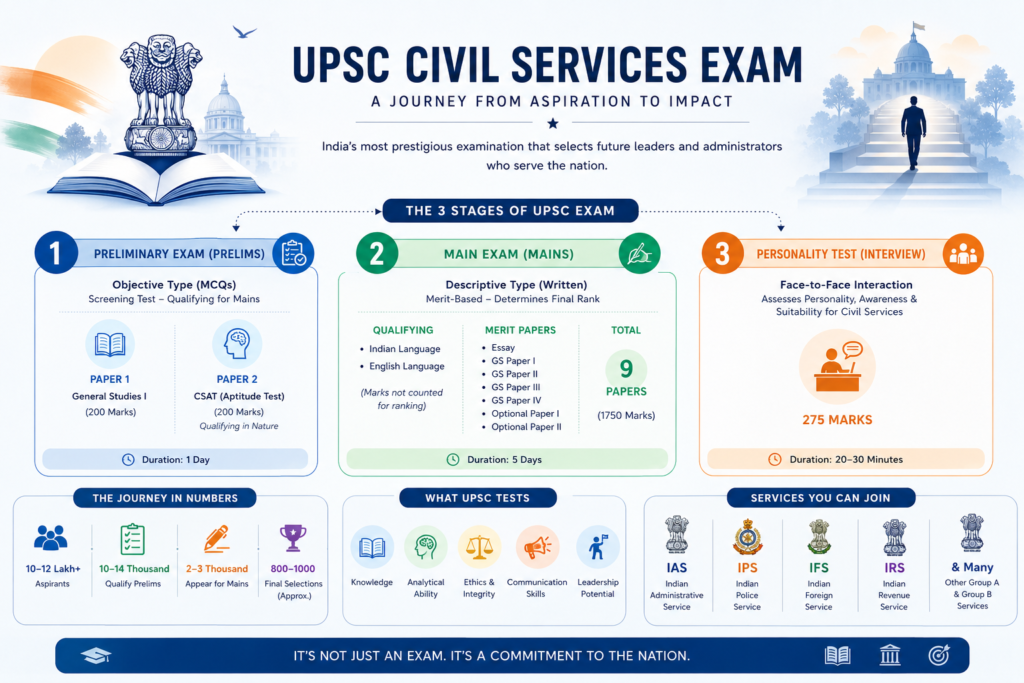
What is UPSC?
The Union Public Service Commission is India’s central recruiting agency responsible for conducting examinations for various government services and posts.
Among its examinations, the Civil Services Examination (CSE) is the most well-known.
Through this examination, candidates are selected for services including:
- IAS (Indian Administrative Service)
- IPS (Indian Police Service)
- IFS (Indian Foreign Service)
- IRS (Indian Revenue Service)
- and several Group A and Group B services.
Stages of the UPSC Civil Services Examination
The UPSC Civil Services Examination is conducted in three major stages:
- Preliminary Examination (Prelims)
- Main Examination (Mains)
- Personality Test (Interview)
A candidate must clear each stage to move to the next.
Stage 1: Preliminary Examination (Prelims)
The Preliminary Examination is the first stage of the UPSC process.
It acts as a screening examination to shortlist candidates for the Mains examination.
Nature of the Exam
The Prelims examination consists of two objective-type papers:
- General Studies Paper I
- CSAT (Civil Services Aptitude Test)
Both papers are conducted on the same day.
General Studies Paper I
This paper determines the cutoff for qualification to the Mains examination.
Subjects generally include:
- History
- Geography
- Indian Polity
- Economy
- Environment
- Science and Technology
- Current Affairs
Important Points
- Multiple-choice questions
- Negative marking applies
- Merit deciding paper
- Usually 100 questions
CSAT Paper
The CSAT paper tests aptitude and reasoning ability.
Topics include:
- Reading comprehension
- Logical reasoning
- Analytical ability
- Basic numeracy
- Decision making
Important Points
- Qualifying in nature
- Candidates need minimum qualifying marks
- Usually considered easier than GS Paper I for many aspirants
Why Prelims is Challenging
Prelims is often considered difficult because:
- the syllabus is vast,
- questions are unpredictable,
- elimination techniques are important,
- and accuracy matters due to negative marking.
Aspirants must develop:
- revision habits,
- current affairs understanding,
- and strong conceptual clarity.
Stage 2: Main Examination (Mains)
Candidates who clear the Preliminary Examination qualify for the Main Examination.
The Mains examination is the most important stage because it carries the majority of marks in the final ranking.
Unlike Prelims, Mains is descriptive in nature.
This stage tests:
- depth of understanding,
- analytical thinking,
- answer writing ability,
- structure and clarity,
- and balanced opinion formation.
Structure of the Mains Examination
The UPSC Mains examination consists of nine papers.
Qualifying Papers
These papers require minimum qualifying marks:
- Indian Language Paper
- English Language Paper
Marks obtained here are not counted in final merit ranking.
Merit Papers
The following papers determine the final ranking:
Essay Paper
Candidates write essays on multiple topics.
This paper evaluates:
- clarity of thought,
- structure,
- articulation,
- and analytical ability.
General Studies Papers
There are four General Studies papers.
GS Paper I
Focuses on:
- History
- Geography
- Indian Society
GS Paper II
Focuses on:
- Governance
- Constitution
- Polity
- International Relations
GS Paper III
Focuses on:
- Economy
- Technology
- Environment
- Security
- Disaster Management
GS Paper IV
Focuses on:
- Ethics
- Integrity
- Aptitude
- Case Studies
Optional Subject Papers
Candidates choose one optional subject.
Examples include:
- Sociology
- Public Administration
- Anthropology
- Geography
- Political Science
- History
- Mathematics
- Literature subjects
The optional subject consists of two papers.
Choosing the right optional subject is considered an important strategic decision.
Importance of Answer Writing
One of the biggest differences between beginners and serious aspirants is answer-writing ability.
UPSC Mains rewards:
- clarity,
- relevance,
- structure,
- multidimensional thinking,
- and concise presentation.
Good answers usually include:
- introduction,
- body,
- balanced analysis,
- examples,
- and conclusion.
Stage 3: Personality Test (Interview)
Candidates who clear the Mains examination are called for the Personality Test, commonly known as the UPSC Interview.
This stage is conducted in front of a UPSC board.
The interview is not merely a question-answer session.
It evaluates:
- personality,
- confidence,
- communication skills,
- ethical thinking,
- decision-making ability,
- awareness,
- and administrative suitability.
Common Areas Asked in Interview
Questions are often based on:
- educational background,
- hometown,
- graduation subject,
- current affairs,
- hobbies,
- work experience,
- and issues related to governance and society.
The board assesses whether the candidate possesses qualities suitable for public service.
Final Merit List
The final merit list is prepared using:
- Mains marks
- Interview marks
Prelims marks are not counted in the final ranking.
Based on rank, preference, category, and vacancies, candidates are allotted services.
Training After Selection
Selected candidates undergo training at various academies.
IAS officers are primarily trained at:
- Lal Bahadur Shastri National Academy of Administration (LBSNAA), Mussoorie.
Training includes:
- governance,
- administration,
- law,
- public policy,
- field exposure,
- and practical administrative learning.
How Long Does the Entire Process Take?
The complete examination cycle usually takes around one year.
A typical timeline:
- Prelims: Mid-year
- Mains: Few months after Prelims
- Interview: Following year
- Final Result: After interviews conclude
Skills Required for Success
Success in UPSC requires more than intelligence.
Important qualities include:
- consistency,
- patience,
- discipline,
- revision,
- critical thinking,
- emotional stability,
- and long-term persistence.
The examination tests endurance as much as knowledge.
Common Mistakes Beginners Make
Many aspirants:
- collect too many resources,
- ignore revision,
- avoid answer writing,
- focus only on current affairs,
- or constantly change strategy.
A focused and structured approach usually works better than excessive material consumption.
Final Thoughts
The UPSC Civil Services Examination is not just an academic test. It is a long process designed to evaluate whether a candidate possesses the knowledge, personality, discipline, and judgment required for public administration and national service.
While the journey is demanding, proper planning, consistency, and conceptual understanding can significantly improve preparation quality.
Understanding the examination process is the first step toward building an effective preparation strategy.
For many aspirants, clarity about the process itself reduces confusion and helps them approach preparation with greater confidence and direction.